The internet has created thousands of abbreviations over the years, but only a handful have remained popular across multiple generations of users. One of those abbreviations is SMH. Whether you’re scrolling through social media, reading text messages, browsing online forums, or chatting with friends, you’ve probably come across this acronym countless times.
Yet many people still wonder about the exact SMH meaning in text, when it should be used, and whether it carries a positive or negative tone.
Understanding internet slang isn’t just about keeping up with trends. It helps you communicate more naturally, understand conversations correctly, and avoid misunderstandings online.
This guide explains everything you need to know about SMH in texting, including its meaning, origin, examples, social media usage, alternatives, and common mistakes people make when using it.
What Does SMH Mean in Text?
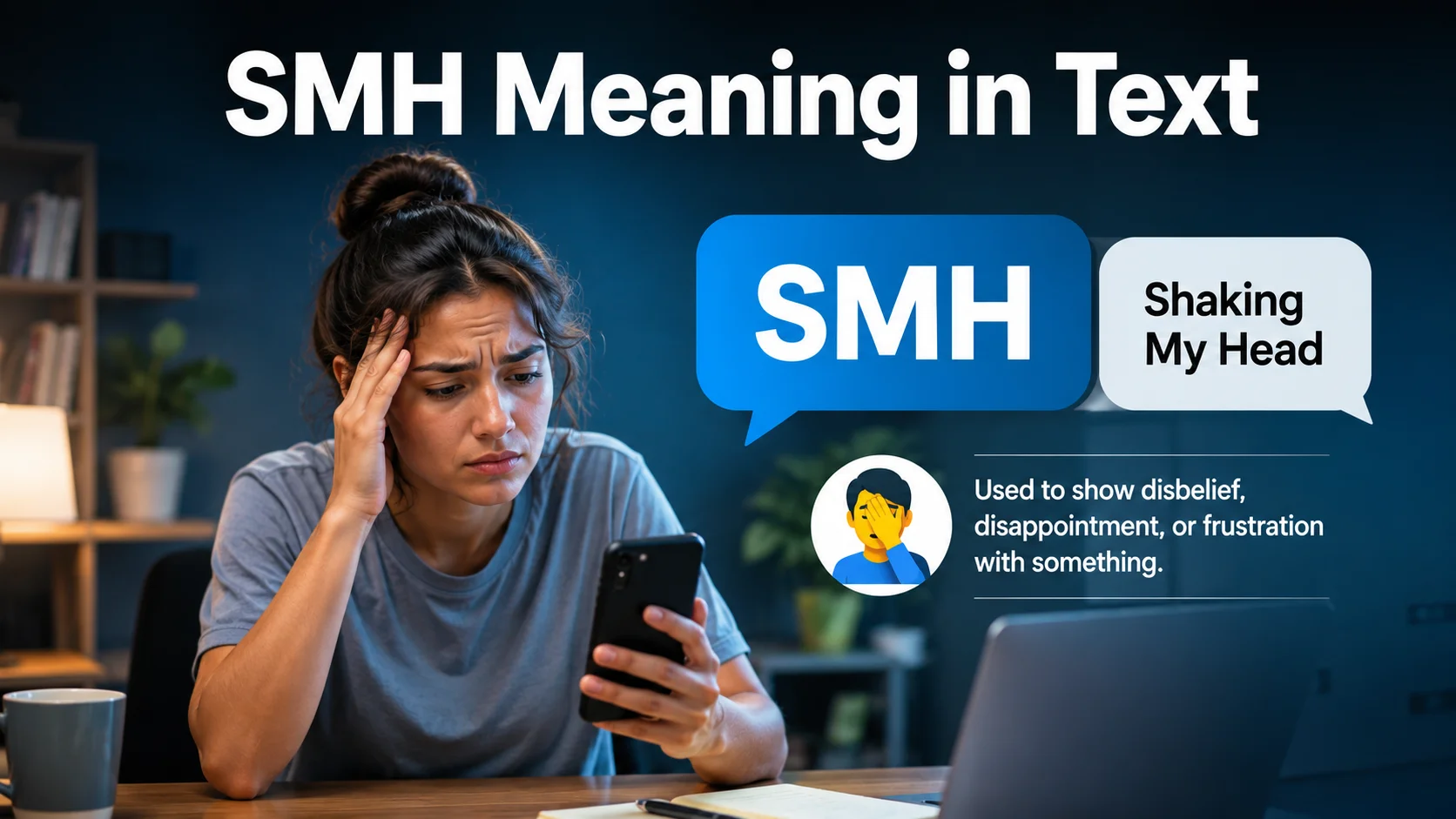
The abbreviation SMH stands for:
“Shaking My Head”
People use it to express disappointment, disbelief, frustration, annoyance, embarrassment, or mild criticism.
Rather than typing a long response, users simply write “SMH” to show that something is foolish, surprising, disappointing, or difficult to believe.
Simple Definition of SMH
At its core, SMH means that someone is figuratively shaking their head in reaction to something.
Imagine watching a friend lock their keys inside their car immediately after telling everyone to be careful.
Your response might simply be:
“SMH.”
That short message communicates frustration, disbelief, and mild amusement all at once.
Quick Meaning Table
| Term | Meaning | Emotion |
| SMH | Shaking My Head | Disappointment |
| SMH | Shaking My Head | Frustration |
| SMH | Shaking My Head | Disbelief |
| SMH | Shaking My Head | Mild Criticism |
| SMH | Shaking My Head | Embarrassment |
How People Usually Use SMH
The meaning often changes slightly depending on context.
People commonly use SMH when:
- Someone makes an obvious mistake
- A situation becomes frustrating
- A person behaves irrationally
- A shocking event occurs
- Someone repeats the same error
- A ridiculous statement appears online
For example:
Friend: “I forgot my passport at home.”
You: “SMH. How did that happen?”
In this example, SMH expresses frustration while remaining lighthearted.
The Origin of SMH
Like many internet abbreviations, SMH emerged during the early days of online communication.
When SMH First Became Popular
Before social media dominated the internet, people communicated through:
- Chat rooms
- Instant messaging services
- Online forums
- Message boards
Typing long responses took time. Users began shortening common phrases to communicate more efficiently.
SMH gained popularity during the early 2000s as texting and instant messaging became part of everyday life.
As platforms like Facebook, Twitter, and Instagram expanded, SMH spread rapidly across the internet.
How the Meaning Has Evolved
Originally, people used SMH primarily to express disappointment.
Today, the abbreviation serves multiple purposes:
- Sarcasm
- Humor
- Frustration
- Mock disbelief
- Embarrassment
- Online commentary
The flexibility of the acronym explains why it remains popular years after its introduction.
How to Use SMH in Text Messages
One reason SMH remains useful is its versatility.
You can place it almost anywhere within a conversation.
SMH at the Beginning of a Message
Starting with SMH immediately sets the emotional tone.
Examples:
- SMH, I can’t believe I missed my flight.
- SMH, people still fall for that scam.
- SMH, that was such an easy question.
The abbreviation acts as a reaction before the main statement.
SMH in the Middle of a Message
Some people insert SMH within a sentence.
Examples:
- My brother forgot his wallet again, SMH, now we’re late.
- She studied the wrong chapter, SMH, that’s unfortunate.
This placement creates a more conversational feel.
SMH at the End of a Message
Ending with SMH emphasizes disappointment.
Examples:
- He left the oven on again SMH.
- I spent two hours on that project and forgot to save it SMH.
- They canceled the event at the last minute SMH.
This usage remains one of the most common forms online.
SMH Examples in Real Conversations
Understanding examples helps clarify how native internet users apply the term.
Friends and Family Texts
Friend: “I dropped my phone in the sink.”
Response: “SMH. Hopefully it still works.”
Sibling: “I forgot my homework again.”
Response: “SMH. That’s the third time this month.”
Friend: “I slept through all five alarms.”
Response: “SMH. That’s impressive.”
Social Media Examples
Common social media posts include:
- “People still believe that rumor? SMH.”
- “The team lost by one point. SMH.”
- “Another delayed flight. SMH.”
These short reactions quickly communicate emotions without requiring lengthy explanations.
Workplace Communication
SMH rarely belongs in professional communication.
Instead of writing:
“SMH, this report has mistakes.”
Use:
“This report contains several errors that need correction.”
Professional settings typically require direct and respectful language.
What Does SMH Mean on Different Platforms?
The meaning remains mostly consistent across platforms.
However, context can influence interpretation.
SMH on Snapchat
On Snapchat, SMH often reacts to:
- Funny mistakes
- Embarrassing moments
- Unexpected photos
- Silly situations
The tone tends to be playful.
SMH on Instagram
Instagram users frequently write SMH in comments when reacting to:
- Viral videos
- Celebrity news
- Controversial posts
- Humorous content
SMH on TikTok
TikTok audiences often use SMH sarcastically.
Examples include:
- Reacting to failed challenges
- Commenting on bad decisions
- Responding to exaggerated stories
SMH on Facebook
Facebook users typically use SMH when discussing:
- News events
- Community issues
- Political discussions
- Personal frustrations
SMH on X (Twitter)
The character limit historically encouraged abbreviations.
As a result, SMH became one of the platform’s most widely used acronyms.
SMH in Gaming Chats
Gamers often type SMH when:
- A teammate makes a poor decision
- Someone ignores instructions
- A player causes a loss
Gaming culture frequently combines SMH with humor and sarcasm.
Different Emotions Conveyed by SMH
Many people assume SMH always means frustration.
In reality, it conveys several emotions.
Frustration
Example:
“The internet went down again. SMH.”
Disappointment
Example:
“They canceled the concert. SMH.”
Embarrassment
Example:
“I sent the message to the wrong person. SMH.”
Disbelief
Example:
“Someone spent $500 on that? SMH.”
Mild Criticism
Example:
“He never reads instructions. SMH.”
Second-Hand Cringe
Example:
“That speech was painful to watch. SMH.”
Context determines which emotion dominates.
Also Read This: KMSL Meaning in Text: Definition and Examples
Common Situations Where People Use SMH
Certain situations trigger SMH more than others.
Obvious Mistakes
Examples:
- Forgetting passwords
- Missing appointments
- Losing important items
Shocking News
Examples:
- Strange headlines
- Unexpected announcements
- Surprising scandals
Customer Service Problems
Examples:
- Long delays
- Incorrect orders
- Poor support experiences
Funny Failures
Examples:
- Walking into a glass door
- Sending texts to the wrong person
- Forgetting birthdays
Repeated Errors
People often use SMH when someone continues making the same mistake repeatedly.
SMH vs Similar Text Abbreviations
Several internet acronyms overlap with SMH.
Understanding the differences helps avoid confusion.
SMH vs OMG
| SMH | OMG |
| Disappointment | Surprise |
| Frustration | Shock |
| Criticism | Excitement |
Example:
- “SMH, he forgot again.”
- “OMG, I won!”
SMH vs Facepalm
Both express disappointment.
However:
- SMH is text-based.
- Facepalm often implies stronger embarrassment.
SMH vs SMDH
SMDH means:
“Shaking My Damn Head”
It intensifies the emotion.
| Term | Intensity |
| SMH | Moderate |
| SMDH | Strong |
SMH vs WTF
WTF usually expresses stronger shock.
SMH often sounds calmer and less aggressive.
SMH vs BRUH
BRUH focuses on disbelief.
SMH focuses on disappointment.
SMH vs LOL
LOL expresses amusement.
SMH expresses criticism or frustration.
What Does SMDH Mean?
Many users encounter SMDH alongside SMH.
Difference Between SMH and SMDH
SMDH stands for:
“Shaking My Damn Head.”
The added word increases emotional intensity.
Examples
SMH Example:
“You forgot your keys again? SMH.”
SMDH Example:
“You forgot your keys for the fifth time this week? SMDH.”
The second version communicates greater frustration.
Is SMH Positive or Negative?
SMH usually carries a negative tone.
However, it isn’t always harsh.
Positive Usage
Sometimes people use SMH jokingly among friends.
Example:
“You ate the entire pizza by yourself? SMH.”
The speaker may actually find the situation funny.
Negative Usage
Most uses involve:
- Disappointment
- Criticism
- Frustration
Humorous Usage
Internet culture frequently uses SMH sarcastically.
This playful usage has helped keep the acronym relevant.
When You Should Avoid Using SMH
Although common online, SMH isn’t appropriate everywhere.
Formal Emails
Avoid abbreviations in professional emails.
Academic Writing
Schools and universities generally prefer complete language.
Business Documents
Professional documents require clarity and formality.
Job Applications
Internet slang can appear unprofessional to employers.
Alternative Ways to Say SMH
Sometimes a different phrase fits better.
Casual Alternatives
- Seriously?
- Come on.
- Really?
- No way.
Funny Alternatives
- Facepalm.
- Bruh.
- You’ve got to be kidding me.
- That’s wild.
Professional Alternatives
- That’s unfortunate.
- That’s disappointing.
- Please review the situation.
- Additional attention is needed.
Full-Phrase Alternatives
Instead of SMH, you can write:
- I’m disappointed.
- I can’t believe this happened.
- That’s frustrating.
- That’s hard to understand.
Most Popular Internet Slang Related to SMH
Internet communication relies heavily on abbreviations.
Here are several commonly used terms.
| Acronym | Meaning |
| IMO | In My Opinion |
| TBH | To Be Honest |
| FOMO | Fear Of Missing Out |
| ICYMI | In Case You Missed It |
| FR | For Real |
| NGL | Not Gonna Lie |
| BRB | Be Right Back |
Understanding these terms makes online conversations easier to follow.
Real-Life Case Study: How Context Changes SMH
Consider these three examples:
Example One
“My friend forgot his umbrella. SMH.”
Emotion: Mild amusement.
Example Two
“The company lost customer data. SMH.”
Emotion: Serious disappointment.
Example Three
“I accidentally wore mismatched shoes. SMH.”
Emotion: Self-directed embarrassment.
The same acronym carries different meanings depending on context.
Quick Reference Guide
| Question | Answer |
| What does SMH mean? | Shaking My Head |
| Is SMH rude? | Usually no |
| Is it formal? | No |
| Can it be funny? | Yes |
| Is it still popular? | Yes |
| Common emotion? | Disappointment |
FAQs:
What does SMH stand for in texting?
SMH stands for “Shaking My Head.” People use it to express disappointment, disbelief, frustration, or mild criticism in digital conversations.
Is SMH rude?
Not usually. Most people use SMH casually. However, context matters. In some situations, it may appear dismissive or critical.
What does SMH mean on Snapchat?
On Snapchat, SMH generally means “Shaking My Head.” Users often employ it when reacting to funny mistakes, embarrassing moments, or surprising messages.
What’s the difference between SMH and SMDH?
SMDH means “Shaking My Damn Head.” It expresses stronger frustration than SMH.
Can SMH be used in professional communication?
Professional communication typically avoids internet slang. Complete sentences create a more polished impression.
Conclusion:
The SMH meaning in text is simple yet surprisingly versatile. Standing for “Shaking My Head,” this popular internet abbreviation allows people to express disappointment, disbelief, frustration, embarrassment, or playful criticism with just three letters.
Its longevity comes from its flexibility. Whether you’re texting friends, commenting on social media, reacting to a viral video, or discussing everyday mistakes, SMH communicates emotions quickly and effectively.
The key to understanding SMH lies in context. Sometimes it signals genuine frustration. Other times it reflects humor, sarcasm, or friendly teasing. Once you recognize those nuances, you’ll have no trouble understanding or using one of the internet’s most enduring abbreviations.