Freedom is one of the most powerful ideas in American culture. It shapes national identity, political values, and personal expression. Because of this, people often turn to visual symbols to represent freedom’s deeper meaning.
Across history, artists, activists, and everyday people have used powerful images to express liberty. Flags, animals, gestures, and ancient motifs all became ways to show independence and human rights. Some symbols emerged from ancient civilizations, while others grew directly from American history.
This guide explores 29 Symbols of Freedom And Their Meanings, explaining where they came from and how people in the United States understand them today. Along the way, we’ll look at their historical roots, emotional meanings, and modern uses—from tattoos to social movements.
Quick Answer
29 Symbols of Freedom And Their Meanings represent ideas like independence, self-determination, and liberation from oppression. In the United States, icons such as the Statue of Liberty, the bald eagle, and broken chains strongly symbolize national liberty, while many others come from older cultural and spiritual traditions.
TL;DR
• Freedom symbols express independence, liberation, and human rights.
• Many originate in ancient mythology or early political revolutions.
• American culture emphasizes liberty through national imagery.
• Today they appear in tattoos, protests, art, and home decor.
• Meanings shift over time depending on cultural context.
What Are Symbols of Freedom?
Symbols of freedom are visual signs people use to express liberty, independence, and self-rule. They often appear in national imagery, protest art, literature, and personal expression.
Because freedom is an abstract concept, symbols help make it visible and emotional. They also allow people to communicate powerful ideas quickly.
Common Traits of Freedom Symbols
• Represent liberation from oppression
• Emphasize personal autonomy or self-determination
• Often linked to revolution or social movements
• Frequently used in national identity imagery
• Inspire hope, courage, and unity
In American culture especially, freedom symbols connect deeply with political ideals and historical struggles for rights.
Historical Origins of Freedom Symbolism
Ancient Roots
Long before modern democracies, ancient cultures used imagery to represent liberation and independence.
In classical Rome, freed slaves sometimes wore a pileus (a soft cap). Over time, this hat became a political symbol of liberty. Later, revolutionary movements revived it as the Phrygian cap, a famous emblem of freedom.
Other ancient civilizations also used symbolic animals, birds, and celestial imagery to represent power, spiritual liberation, or divine protection.
Revolutionary Era Influence
During the 1700s and 1800s, freedom symbols expanded dramatically.
Political revolutions in America and Europe adopted clear imagery to communicate their ideals to the public.
Important historical influences include:
• Revolutionary flags and emblems
• Classical Roman liberty symbols
• Enlightenment political ideas
• Early protest imagery and pamphlets
• National monuments and patriotic art
Many symbols recognized today grew from this era.
29 Symbols of Freedom And Their Meanings
Below are some of the most recognized symbols of freedom across cultures, with strong meaning in the United States.
National and Political Symbols
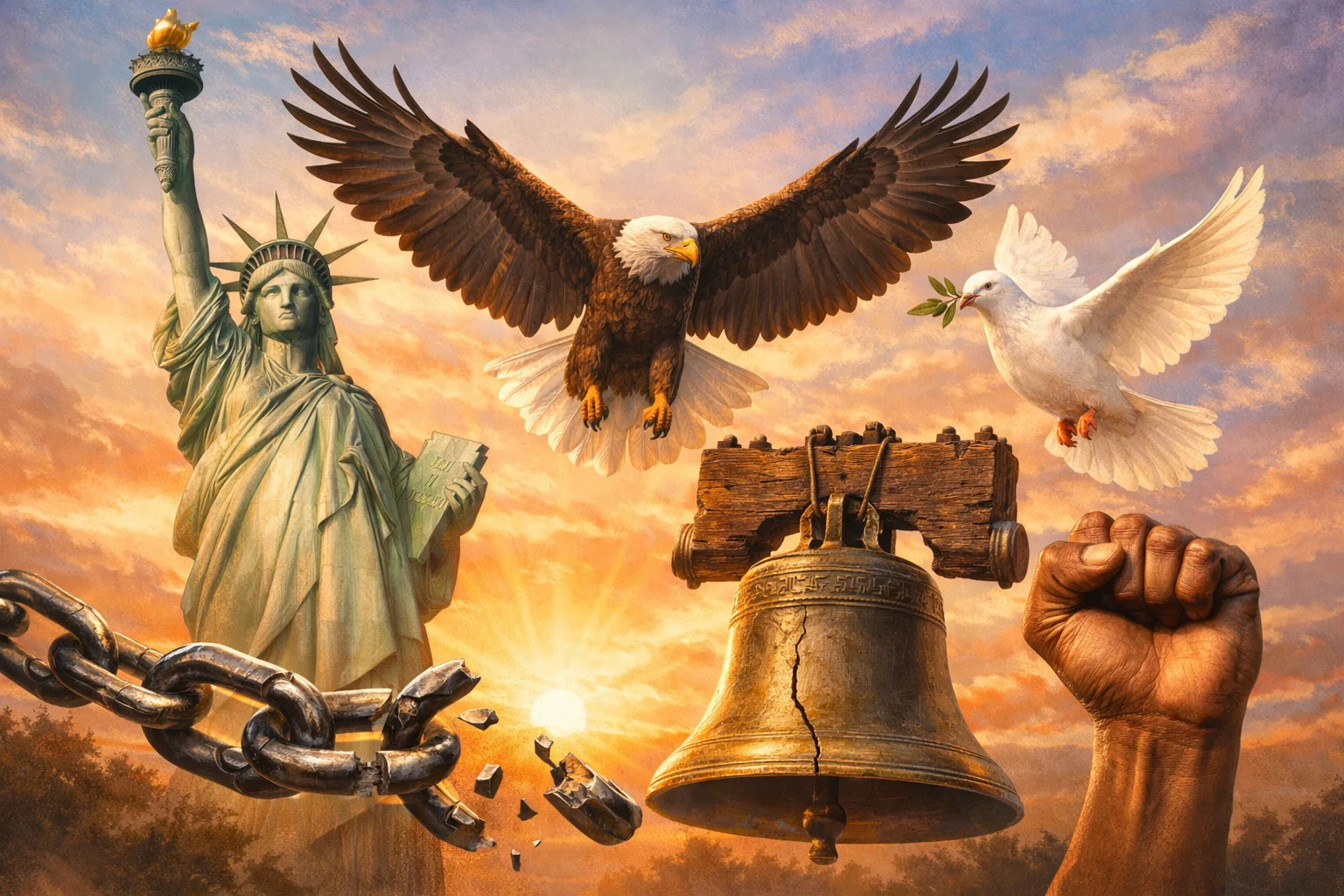
• Statue of Liberty — welcome, democracy, and refuge
• Liberty Bell — American independence and justice
• Bald Eagle — national strength and independence
• American Flag — unity, rights, and constitutional freedom
• Torch of Liberty — enlightenment and progress
Universal Symbols
• Broken chains — liberation from oppression
• Flying bird — escape and spiritual freedom
• Open road — limitless opportunity
• Open sky — unrestricted possibility
• Wings — transcendence and independence
Historical and Cultural Symbols
• Phrygian cap — revolutionary liberty
• Liberty tree — political resistance and rights
• Laurel wreath — victory and honor
• Olive branch — peaceful freedom
• Freedom dove — peace and hope
Modern Cultural Symbols
• Raised fist — resistance and empowerment
• Peace sign — anti-war freedom movements
• Feather — spiritual freedom
• Butterfly — transformation and release
• Anchor — freedom through stability
Additional Freedom Motifs
• Key — unlocking new possibilities
• Broken cage — escape from confinement
• Sunrise — new beginnings
• Torch — truth and enlightenment
• Open wings eagle — power and autonomy
• Compass — choosing one’s own path
• Mountain peak — overcoming barriers
• Flag waving — patriotic liberty
• Open door — opportunity and choice
Together, these images form a broad symbolic language around freedom.
Freedom Symbols in American Culture
In the United States, freedom symbolism is deeply tied to national identity.
American history includes multiple struggles for liberty: independence from Britain, civil rights movements, and ongoing debates about personal rights.
Core American Freedom Icons
• Statue of Liberty representing immigration and opportunity
• Liberty Bell representing independence in 1776
• Bald eagle symbolizing national power and autonomy
• American flag representing unity and constitutional ideals
• Torch imagery representing enlightenment
These symbols appear in monuments, government buildings, and education.
They also show up during national holidays such as the Fourth of July.
Cross-Cultural and Spiritual Meanings of Freedom
Freedom symbolism exists in nearly every culture.
However, the meaning sometimes shifts depending on spiritual beliefs or historical context.
Examples Across Cultures
• Doves often represent spiritual peace in many religions
• Butterflies symbolize transformation in Asian traditions
• Eagles represent divine power in many Indigenous cultures
• Feathers represent spiritual freedom in Native traditions
• Open skies symbolize divine connection in many mythologies
Although the meanings vary, the core idea remains similar: liberation and transcendence.
Emotional and Psychological Meaning of Freedom Symbols
Freedom symbols evoke strong emotions.
Because liberty is tied to personal identity and human rights, these images often carry deep psychological weight.
Feelings Often Linked to Freedom Symbols
• Hope for a better future
• Courage to resist oppression
• Pride in national identity
• Personal empowerment
• Desire for independence
People may use these symbols to express personal values or life philosophies.
Modern Uses: Tattoos, Art, and Social Media
Today, freedom symbols appear everywhere in daily life.
Many people choose them to represent personal journeys, beliefs, or cultural identity.
Common Modern Uses
• Tattoos of birds, feathers, or broken chains
• Protest signs and political artwork
• Jewelry with wings or keys
• Social media graphics representing independence
• Home decor with patriotic imagery
Because these symbols are visual and emotional, they work well in modern storytelling and design.
Also Read This: Butterfly Symbolism: Spiritual Meaning Behind the Animal
Misunderstandings and Controversies
Not all uses of freedom symbols are universally positive.
Some images have been misused or politicized in ways that create controversy.
Examples of Symbolic Tension
• National symbols sometimes used in partisan politics
• Protest symbols interpreted differently by groups
• Historical symbols repurposed by extremist groups
• Cultural symbols used without proper understanding
Because symbolism evolves, meaning often depends on context.
Most symbols still carry positive interpretations, but awareness matters.
How Freedom Symbolism Has Changed Over Time
Symbols rarely stay fixed in meaning.
As societies evolve, the interpretation of images shifts as well.
Major Changes Over Time
• Ancient symbols revived during revolutions
• National icons becoming cultural identity markers
• Protest symbols gaining global recognition
• Social media spreading symbolism quickly
• Older meanings sometimes fading or transforming
For example, the raised fist once symbolized labor movements but now appears in many equality movements.
Freedom Symbols in Different Contexts
Different settings give freedom symbols slightly different meanings.
| Context | Meaning in the USA | Common Associations | Notes |
| National monuments | Patriotism and independence | Liberty, democracy | Often linked to historical events |
| Protest movements | Resistance and civil rights | Equality, justice | Meaning depends on movement |
| Tattoos | Personal liberation | Self-expression | Often chosen after life changes |
| Art and design | Inspirational themes | Hope and empowerment | Popular in motivational imagery |
| Education | Civic values | History and rights | Used to teach American ideals |
This flexibility helps freedom symbolism remain powerful across generations.
Why Freedom Symbols Matter Today
Even in modern digital culture, symbols still shape how people think and communicate.
Images can express powerful ideas instantly.
Reasons They Remain Important
• They unite people around shared ideals
• They preserve historical memory
• They inspire social change
• They communicate values quickly
• They strengthen cultural identity
Because of this, freedom symbols remain deeply influential in American society.
FAQs
What is the most famous symbol of freedom?
In the United States, the Statue of Liberty is widely considered the most famous symbol of freedom. It represents liberty, democracy, and the welcoming of immigrants.
Why do birds symbolize freedom?
Birds symbolize freedom because they can fly freely across the sky. This natural ability represents independence and escape from limitations.
What does a broken chain symbolize?
Broken chains symbolize liberation from oppression, slavery, or confinement. They are often used in historical and civil rights imagery.
Why is the eagle a freedom symbol?
The eagle represents strength, independence, and power. In American symbolism, the bald eagle reflects national autonomy and courage.
What does the torch symbolize in freedom imagery?
A torch often represents enlightenment, truth, and progress. In liberty symbolism, it suggests guiding people toward freedom.
Are freedom symbols universal?
Many freedom symbols appear across cultures, but their meanings may vary. However, the core idea of liberation usually remains consistent.
Conclusion
Throughout history, people have relied on powerful imagery to express the idea of liberty. From ancient symbols to modern national icons, visual language helps communicate complex ideals in a simple way.
The 29 Symbols of Freedom And Their Meanings explored in this guide reveal how cultures represent independence, hope, and human dignity. In the United States especially, these symbols are deeply tied to national identity and democratic values.
Even today, freedom symbols continue to evolve. They appear in monuments, art, activism, and personal expression. And as long as people value liberty, these timeless images will continue to carry meaning for generations to come.